Book tlt.gs/accessibilitycoombs online discussion 3/11 2pmET tlt.gs/frlv
Many expect technology to assist those with disabilities and increase access, but ironically some tech "improvements" create more barriers at the same time as lowering previous ones.
Two Chronicle articles (Dec 2010) provide apt background for Norm Coomb's Bookgroup FridayLive! this Friday 2:00pm ET. Coombs, CEO of EASI, and author of Making Online Teaching Accessible will share his thoughts on inclusive course design. We hope you will join us. Register by clicking the FridayLive! button.
Why, despite ADA legislation and a generally receptive attitude towards individuals with disabilities, is it still so hard to comply, to make access more universal? Getting beyond the nod is apparently really hard. We've all read articles about obstacles to accessibility. These two articles are no exception.
http://chronicle.com/article/Blind-Students-Demand-Access/125695/
http://chronicle.com/article/Cal-States-Strong-Push-for/125683/
What was especially interesting was the juxtaposition of the individual and institutional obstacles with some significant successes.
The online student center at Arizona State University is based on a Facebook type application which isn't user friendly to those with visual impairments.
On the other hand, Darrell Shandrow, the focus of the piece, was willing to be vocal and demanding in spite of the institutional and even family resistance. And CSU, the focus of the second piece, pressed "Apple, Google, and Blackboard to improve their software or lose the ability to reach Cal State's 430,000 students." These efforts took time and persuasion and the work of advocates who weren't satisfied with a nod to accessibility.
http://chronicle.com/article/Blind-Students-Demand-Access/125695/
http://chronicle.com/article/Cal-States-Strong-Push-for/125683/

Thursday, March 10, 2011


Sample MP3 audio & automatic text transcript
Used Philips "Voice Tracer" Digital recorder to produce and upload audio file to my computer. Used Dragon Naturally Speaking 11 Premium to produce text transcript. DID NOT EDIT AUDIO OR TEXT AT ALL.
If the links below don't work as expected, go instead to the Google Sites Web page from which this was copied and pasted: http://tlt.gs/4bcf
---------------------------------------------------------------------
SAMPLE AUDIO FILE (MP3) AND TEXT TRANSCRIPT PRODUCED AUTOMATICALLY
Has technology advanced enough so that people who have little technical expertise can now produce adequate quality versions of BOTH text and audio for the same information without doubling their efforts?
Can the quality of BOTH the two elements produced - the sound recording and the text transcript - of sufficient quality to be useful in making online information more effectively accessible to people who have difficulty with vision or hearing?
PURPOSE: This Web page provides an audio recording and a text transcript of that recording. Both were produced and made available on the web with very little time or expense. We welcome comments about the adequacy of the quality of these two elements for making online information more widely and fully accessible to people who have vision or hearing deficits. We welcome suggestions about tools and services for producing sound and text transcripts with some or all of these characteristics:
1. Produce better quality than these examples
2. Have an even lower threshold for learning how to use - especially, for learning just enough to BEGIN to use in the simplest but worthwhile ways
3. More widely available, accessible, or inexpensive
The recording that you can play here has been uploaded as a small MP3 file of 50kb to this Website.
Following this paragraph is a control that allows you to play the audio recording with one click.
Below that is a text transcription of the recording. That transcription was produced by Dragon 11 Premium on March 7, 2011. That software had been trained for about one hour a few months ago by Steve Gilbert to reduce errors when transcribing his voice recordings from a digital recording device.
HERE IS THE TRANSCRIPTION:
Flow this is Steve Gilbert, president of the TLT group. I'm recording without any editing or redoing I want to see how well this works. I'm talking a little more forcefully than I would normally but I'm using my works digital recording device. I'd like to know if doing this once without any retakes or changes is adequate with dragon transcription
END OF TRANSCRIPTION
- Click here for more info about
Making Online Teaching Accessible: Inclusive Course Design for Students with Disabilities by Norman Coombs
- Click here for more info about the free online discussion of this book Friday March 12, 2011 2pm ET
- Click here to download a copy of the mp3
Monday, March 07, 2011
Help online accessibility for disabilities? Record audio online free?
Try my Broadcastr.com test for FridayLive 3/12? http://t.co/mJZ6iti
Using the preceding link, can you easily play the brief recording I just made?
----------------------------
"...the service lets users record, publish and geo-tag stories to share...
"To use Broadcastr, just record your story, review and re-record (if needed), add some tags and pin it to a location. You can create playlists to group recordings, and users can follow particular storytellers or share stories via e-mail, Twitter and Facebook.
"The Web site has a few loading and interface bugs..."
- from "Create your own walking tour with Broadcastr" by Hayley Tsukayama Wash. Post 3/6/11
"Broadcastr offers an application that lets people record audio stories tagged to specific geographical locations around the world. The storytellers, Broadcastr hopes, will both create compelling tales and imbue places with new meanings through the voices of strangers. ...
"Broadcastr is yet another logical evolution in the democratization of media and storytelling,...
"Broadcastr describes itself this way: 'We tweet. We blog. We YouTube. We connect on Facebook. What about our voices? Now, we broadcast them. Broadcastr is a new Social Media platform. Anyone, anywhere in the world, can record, index, listen to, and share audio via a map-based interface. From the historical to the hysterical, the hilarious to the anecdotal, Broadcastr amplifies all our voices.'"
- From "Broadcastr Unveiled: Storytelling Goes Social, Local and Viral" By ALEX SALKEVER Posted 4:00 PM 12/18/10 See full article from DailyFinance:http://srph.it/eCLDLt
Using the preceding link, can you easily play the brief recording I just made?
----------------------------
 |
"To use Broadcastr, just record your story, review and re-record (if needed), add some tags and pin it to a location. You can create playlists to group recordings, and users can follow particular storytellers or share stories via e-mail, Twitter and Facebook.
"The Web site has a few loading and interface bugs..."
- from "Create your own walking tour with Broadcastr" by Hayley Tsukayama Wash. Post 3/6/11
"Broadcastr offers an application that lets people record audio stories tagged to specific geographical locations around the world. The storytellers, Broadcastr hopes, will both create compelling tales and imbue places with new meanings through the voices of strangers. ...
"Broadcastr is yet another logical evolution in the democratization of media and storytelling,...
"Broadcastr describes itself this way: 'We tweet. We blog. We YouTube. We connect on Facebook. What about our voices? Now, we broadcast them. Broadcastr is a new Social Media platform. Anyone, anywhere in the world, can record, index, listen to, and share audio via a map-based interface. From the historical to the hysterical, the hilarious to the anecdotal, Broadcastr amplifies all our voices.'"
- From "Broadcastr Unveiled: Storytelling Goes Social, Local and Viral" By ALEX SALKEVER Posted 4:00 PM 12/18/10 See full article from DailyFinance:http://srph.it/eCLDLt
Friday, March 04, 2011
Vision Worth Working Toward = VWWT
A "Vision Worth Working Toward" is more than an expectation and less than a prediction. It must be an inspiring but plausible goal that participants can work toward and make visible progress - soon. tlt.gs/VWWT
Thursday, March 03, 2011
"... half of all students score below median!" ... what to do?

Can that be a coincidence, or is it the result of incompetent teachers or a teachers' union conspiracy to subvert the Republic?" - Facebook: John Stuckey 20110303
Certainly never happened in my courses!
Steve Gilbert
Wednesday, March 02, 2011
Higher Ed in Crisis Requiring Radical Change?
"...technology can move so fast that institutions must either adapt or die..." Colleges & universities? Banking, music, newspapers?
"...the pace of change of options presented to higher ed by social/networked technologies far outstrips the pace of pedagogical change and institutional innovation in higher ed.
This Friday we'll discuss Social Networking in/for higher education - FridayLive! Free online 2pm ET March 4, 2011. We'll also consider how the pace of change varies among individuals, institutions, and industries.... [and countries? cultures? civilizations?] The inventors, pioneers, vanguard enthusiasts who have unusual roles in these changes, may also have unusual perspectives, hopes and fears. Hopes for the most utopian consequences, fears of the most pedestrian distortions.
Right now we can see a remarkable sequence of international events - clashes between political systems, individual initiatives, and emerging communities - that vividly demonstrates how motivation and need can accelerate the use of new technologies. Urgency has overcome the thresholds of apparent complexity that usually delay rapid implementation.
Above paraphrases and excerpts email exchange among Derek Bruff , Jim Julius & Steve Gilbert today (3/2) in preparation for FridayLive! March 4, 2011 2pm ET free online discussion/Webcast/Webinar.
Right now we can see a remarkable sequence of international events - clashes between political systems, individual initiatives, and emerging communities - that vividly demonstrates how motivation and need can accelerate the use of new technologies. Urgency has overcome the thresholds of apparent complexity that usually delay rapid implementation.
Above paraphrases and excerpts email exchange among Derek Bruff , Jim Julius & Steve Gilbert today (3/2) in preparation for FridayLive! March 4, 2011 2pm ET free online discussion/Webcast/Webinar.
Also see Bruff's discussion of "participatory culture" in his blog posting of Jan 29, 2011: What Happens When Everyone Has a Voice | Teaching with Classroom Response Systems
"I just want the world to make sense" Social Networking for the Overloaded
Blogs, Facebook, Twitter, Wikis, Listservs, Groups, Discussion Boards, ... What do these things really do? Why? How? Who cares? Who should care? How do they help/hinder teaching and learning? How could they?
I doubt that most people who have been using Twitter recently knew they were using "hashtags" or "widgets" - especially those using some of Twitter's simplest and most effective capabilities to coordinate recent political activities in the Middle East. [ Simplest explanation of Twitter hash tags I've found yet!] See below for more...
MISLEADING TERMINOLOGY
Labels first assigned to important new tools and functions of "social networking technologies" are often selected by those who are immersed in the technology itself and who are prone to extend insider terminology and create cute acronyms. Gratuitously cryptic terminology can make new tools seem more complex and mysterious than necessary - especially to the next wave of potential users. We hope to provide explanations and examples that reduce these linguistic obstacles and enable educators to take advantage of these tools' emerging capabilities to support improvements in teaching and learning.
This criticism is irrelevant and the need for simpler intermediate explanations vanishes when the new users are desperate. That was powerfully demonstrated in the Middle East early in 2011.
POWER OF SOCIAL NETWORKING TECHNOLOGY IN MIDDLE EAST 2011
"Unedited, raw, anonymous and emotional, Egyptian voices are trickling out through a new service that evades attempts by the authorities to suppress them by cutting Internet services." - from "New Service Lets Voices From Egypt Be Heard," By CHRISTINE HAUSER, New York Times, Published: February 1, 2011
Some weekend work that will (hopefully) enable more Egyptians to be heard"
I doubt that most people who have been using Twitter recently knew they were using "hashtags" or "widgets" - especially those using some of Twitter's simplest and most effective capabilities to coordinate recent political activities in the Middle East. [ Simplest explanation of Twitter hash tags I've found yet!] See below for more...
Also see the Overloadtiorium: "If working 24 hours a day isn't enough, you have to work nights."
JUST WANT THE WORLD TO MAKE SENSE
"...I just want the world to make sense. ...There it was, the one thing everybody wanted, and the one thing nobody got. ... She'd lived a life that made the unpleasant truth easy to avoid - and now she must have run into something that made it so clear, she couldn't get around it." - Jane Haddam, Not a Creature Was Stirring, Doubleday, 1993, pp. 77-78
MISLEADING TERMINOLOGY
Labels first assigned to important new tools and functions of "social networking technologies" are often selected by those who are immersed in the technology itself and who are prone to extend insider terminology and create cute acronyms. Gratuitously cryptic terminology can make new tools seem more complex and mysterious than necessary - especially to the next wave of potential users. We hope to provide explanations and examples that reduce these linguistic obstacles and enable educators to take advantage of these tools' emerging capabilities to support improvements in teaching and learning.
This criticism is irrelevant and the need for simpler intermediate explanations vanishes when the new users are desperate. That was powerfully demonstrated in the Middle East early in 2011.
POWER OF SOCIAL NETWORKING TECHNOLOGY IN MIDDLE EAST 2011
"Unedited, raw, anonymous and emotional, Egyptian voices are trickling out through a new service that evades attempts by the authorities to suppress them by cutting Internet services." - from "New Service Lets Voices From Egypt Be Heard," By CHRISTINE HAUSER, New York Times, Published: February 1, 2011
No Internet connection is required. People can listen to the messages by dialing the same phone numbers or going to
Some weekend work that will (hopefully) enable more Egyptians to be heard"
Tuesday, March 01, 2011
Eat 100,000 poor children; Add 5 students to each top teacher's class?
2 Modest Proposals?
1. Sell 100,000 children per year to be "stewed, roasted, baked, or boiled; ..." - from "A Modest Proposal for preventing the children of poor people in Ireland, from being a burden on their parents or country, and for making them beneficial to the publick." by Jonathan Swift 1729 - more text, citation below.
2. "...get more students in front of top teachers by identifying the top 25 percent of teachers and asking them to take on four or five more students. Part of the savings could then be used to give the top teachers a raise." - from "How teacher development could revolutionize our schools" by Bill Gates 2011 - more text, citation below. [Where might these 'savings' come from? From firing and not replacing 25 percent of the non-top teachers? - Steve Gilbert, 2011]
Citations/More...
2. "...get more students in front of top teachers by identifying the top 25 percent of teachers and asking them to take on four or five more students. Part of the savings could then be used to give the top teachers a raise." - from "How teacher development could revolutionize our schools" by Bill Gates 2011 - more text, citation below. [Where might these 'savings' come from? From firing and not replacing 25 percent of the non-top teachers? - Steve Gilbert, 2011]
Citations/More...
1. "... hundred thousand may, at a year old, be offered in sale to the persons of quality and fortune, through the kingdom, always advising the mother to let them suck plentifully in the last month, so as to render them plump, and fat for a good table." Swift, Jonathan. “A modest proposal.” 1729. Quotidiana. Ed. Patrick Madden. 19 Dec 2007. 17 Feb 2010 http://essays.quotidiana.org/swift/modest_proposal/
2. "...Our goal is a new approach to development and evaluation that teachers endorse and that helps all teachers improve.
"The value of measuring effectiveness is clear when you compare teachers to members of other professions - farmers, engineers, computer programmers, even athletes. These professionals are more advanced than their predecessors - because they have clear indicators of excellence, their success depends on performance and they eagerly learn from the best.
"The same advances haven't been made in teaching because we haven't built a system to measure and promote excellence. Instead, we have poured money into proxies, things we hoped would have an impact on student achievement. The United States spends $50 billion a year on automatic salary increases based on teacher seniority. It's reasonable to suppose that teachers who have served longer are more effective, but the evidence says that's not true. After the first few years, seniority seems to have no effect on student achievement.
"Another standard feature of school budgets is a bump in pay for advanced degrees. Such raises have almost no impact on achievement, but every year they cost $15 billion that would help students more if spent in other ways.
"Perhaps the most expensive assumption embedded in school budgets - and one of the most unchallenged - is the view that reducing class size is the best way to improve student achievement. This belief has driven school budget increases for more than 50 years. U.S. schools have almost twice as many teachers per student as they did in 1960, yet achievement is roughly the same.
"What should policymakers do? One approach is to get more students in front of top teachers by identifying the top 25 percent of teachers and asking them to take on four or five more students. Part of the savings could then be used to give the top teachers a raise. (In a 2008 survey funded by the Gates Foundation, 83 percent of teachers said they would be happy to teach more students for more pay.) "
"The value of measuring effectiveness is clear when you compare teachers to members of other professions - farmers, engineers, computer programmers, even athletes. These professionals are more advanced than their predecessors - because they have clear indicators of excellence, their success depends on performance and they eagerly learn from the best.
"The same advances haven't been made in teaching because we haven't built a system to measure and promote excellence. Instead, we have poured money into proxies, things we hoped would have an impact on student achievement. The United States spends $50 billion a year on automatic salary increases based on teacher seniority. It's reasonable to suppose that teachers who have served longer are more effective, but the evidence says that's not true. After the first few years, seniority seems to have no effect on student achievement.
"Another standard feature of school budgets is a bump in pay for advanced degrees. Such raises have almost no impact on achievement, but every year they cost $15 billion that would help students more if spent in other ways.
"Perhaps the most expensive assumption embedded in school budgets - and one of the most unchallenged - is the view that reducing class size is the best way to improve student achievement. This belief has driven school budget increases for more than 50 years. U.S. schools have almost twice as many teachers per student as they did in 1960, yet achievement is roughly the same.
"What should policymakers do? One approach is to get more students in front of top teachers by identifying the top 25 percent of teachers and asking them to take on four or five more students. Part of the savings could then be used to give the top teachers a raise. (In a 2008 survey funded by the Gates Foundation, 83 percent of teachers said they would be happy to teach more students for more pay.) "
- Bill Gates, co-chair of the Bill and Melinda Gates Foundation, Washington Post, Feb 28, 2011, p A15; online at http://www.washingtonpost.com/wp-dyn/content/article/2011/02/27/AR2011022702876.html
Friday, February 25, 2011
Perfection: Take away or add?
"Perfection is achieved, not when there is nothing more to add, but when there is nothing left to take away." -- Antoine de Saint-Exupery From The Quotations Page
And Gracie Allen "Always removed a piece of jewelery when going out so she wouldn't be 'overdressed'" -- Wikipedia entry about Gracie Allen
Thanks to Avery Boyce for 1st quote above, Steve Ehrmann for 2nd!
Wednesday, February 23, 2011
Stand up. Move now! "Are you using your laptop unsafely?"
Lacking self-discipline, I force myself to get up and move every hour when working on computer.
WHY? [more below from UC Berkeley]
Laptop configuration is not ergonomically desirable. Sitting without moving much for longer than 60 minutes is not healthy for human beings. That probably includes raptly attentive students during college lectures!
GOAL
So, I always have my computer monitor physically detached from my computer keyboard - whether desktop or laptop - even when traveling (bring extra keyboard with laptop - put laptop on overturned ice-bucket on desk in hotel room). And I avoid zombie-like immobility when working.
HOW - HOME OFFICE
Plug computer monitor power cables into a VERY long extension cord.
Plug extension cord into timer in an outlet in basement.
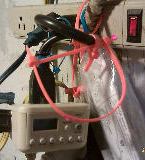 Set timer for 60 to 75 minutes.
One hour later, monitors go entirely black. No matter how intently I'm working, I must stop immediately, but my work is safe.
Walk through several rooms and up and down flight of stairs to get to the timer, reset it, and return to my desk.
Thus, I force myself to move and get at least a little exercise!
Have you found a better way that does not rely on self-discipline any more than this? Let me know.
WHY - ERGONOMICS@WORK UC Berkeley's Ergonomics Program for Faculty and Staff
"Take frequent stretch breaks every 30 to 45 minutes"
http://www.uhs.berkeley.edu/facstaff/pdf/ergonomics/laptop.pdf
 |
| How? Remote Timer! |
Laptop configuration is not ergonomically desirable. Sitting without moving much for longer than 60 minutes is not healthy for human beings. That probably includes raptly attentive students during college lectures!
GOAL
So, I always have my computer monitor physically detached from my computer keyboard - whether desktop or laptop - even when traveling (bring extra keyboard with laptop - put laptop on overturned ice-bucket on desk in hotel room). And I avoid zombie-like immobility when working.
HOW - HOME OFFICE
Plug computer monitor power cables into a VERY long extension cord.
Plug extension cord into timer in an outlet in basement.
One hour later, monitors go entirely black. No matter how intently I'm working, I must stop immediately, but my work is safe.
Walk through several rooms and up and down flight of stairs to get to the timer, reset it, and return to my desk.
Thus, I force myself to move and get at least a little exercise!
Have you found a better way that does not rely on self-discipline any more than this? Let me know.
WHY - ERGONOMICS@WORK UC Berkeley's Ergonomics Program for Faculty and Staff
"Take frequent stretch breaks every 30 to 45 minutes"
http://www.uhs.berkeley.edu/facstaff/pdf/ergonomics/laptop.pdf
Friday, February 18, 2011
Thursday, February 17, 2011
Twitter - Starting A Revolution? International? Higher educ?
"Twitter co-founder Biz Stone ... how it was used recently in Egypt to help organize the revolution and how it has been used to spread democracy movements in other countries."
Fuller description of this interview, link to podcast, etc. avail at:
http://www.npr.org/2011/02/16/
No one can ignore the extraordinary pace and impact of Twitter's emerging role in international communications, politics, revolution. But, what are the implications for teaching and learning?
What can we do with Twitter in higher education?
Constructively - not merely forbidding it's use by students in some classrooms? Recognizing its growing availability, accessibility, low cost.
See recent work, discussions by Derek Bruff et al.
http://derekbruff.com/site/blog/2010/11/01/twitter-101-for-a-conference-backchannel/
http://twitter.com/#!/derekbruff
Fuller description of this interview, link to podcast, etc. avail at:
http://www.npr.org/2011/02/16/
No one can ignore the extraordinary pace and impact of Twitter's emerging role in international communications, politics, revolution. But, what are the implications for teaching and learning?
What can we do with Twitter in higher education?
Constructively - not merely forbidding it's use by students in some classrooms? Recognizing its growing availability, accessibility, low cost.
See recent work, discussions by Derek Bruff et al.
http://derekbruff.com/site/blog/2010/11/01/twitter-101-for-a-conference-backchannel/
http://twitter.com/#!/derekbruff
Wednesday, February 09, 2011
Frugal Innovations - The Workshop
1. What? Why?
2. Which One?
Form small group. Discuss each others' improvements. Select one for the group.
3. How?
Develop 1st draft of materials to introduce this improvement.
4 Who, When, Where? Strategy
Develop plan for use of materials to share this improvement.
"Why me? Why now?"
TMI/TMO/TLT/TL$
Sample Workshop Plan/Resources - Evolving rapidly
Used at Lilly-Greensboro 2011 Conference - Feb, 2011
-----------------------------------------------------
Notes - to be integrated above soon! SWG 20110209
Strategy
Individuals each identify one or two shareworthy, low-threshold, shareable improvements in teaching/learning with technology from their own experience.
Form small group. Discuss each others' improvements. Select one for the group.
3. How?
Develop 1st draft of materials to introduce this improvement.
4 Who, When, Where? Strategy
Develop plan for use of materials to share this improvement.
"Why me? Why now?"
TMI/TMO/TLT/TL$
Sample Workshop Plan/Resources - Evolving rapidly
Used at Lilly-Greensboro 2011 Conference - Feb, 2011
-----------------------------------------------------
Notes - to be integrated above soon! SWG 20110209
Strategy
Satisficing
Local Politics
priorities, resources, limitations, opportunities
Friday, February 04, 2011
Shareworthy, low-threshold, shareable improvement in T/L sample
Produced today in Lilly Conf workshop. More: tlt.gs/FISELillyGSO2011
Frugal Innovations for Student Engagement:
Collegial Sharing of ImprovementsLilly Greensboro 2011
10:15-11:30AM Friday, February 4, 2011
Example of a shareworthy, low-threshold, shareable improvement - produced by small group during workshop Feb 4, 2011
"Learn, Teach, Learn" Activity
1. Students learn a new concept
2. Students prepare to teach this specific concept to peer students, using "their own way of teaching"
3. Students teach this specific concept to [some? many? one? optional?] peer students
Copy of paper bookmark first draft produced by this group and scanned with permission: [click on this image to see larger more legible version]

Sunday, January 02, 2011
Learning Cures Sadness...
"The best thing for being sad is to learn something."
Background: Merlyn, responsible for raising the boy who is destined to become the king of England, is an unusual teacher. Here, he advises young Wart/Arthur how to cope with frustration and sadness.
More of excerpt from T. H. White's The Once and Future King:
"The best thing for being sad," replied Merlyn, beginning to puff and blow, "is to learn something. That is the only thing that never fails. You may grow old and trembling in your anatomies, you may lie awake at night listening to the disorder of your veins, you may miss your only love, you may see the world about you devastated by evil lunatics, or know your honour trampled in the sewers of baser minds. There is only one thing for it then--to learn. Learn why the world wags and what wags it. That is the only thing which the mind can never exhaust, never alienate, never be tortured by, never fear or distrust, and never dream of regretting. Learning is the thing for you. Look at what a lot of things there are to learn--pure science, the only purity there is. You can learn astronomy in a lifetime, natural history in three, literature in six. And then, after you have exhausted a milliard lifetimes in biology and medicine and theocriticism and geography and history and economics--why, you can start to make a cartwheel out of the appropriate wood, or spend fifty years learning to begin to learn to beat your adversary at fencing. After that you can start again on mathematics, until is it is time to learn to plough."
Excerpt from T. H. White's The Once and Future King, Berkeley Medallion Edition, July, 1966, page 183.
Thursday, December 23, 2010
What do you cherish and want not to lose?
Transform AND Preserve: Teaching and Learning with Technology tlt.gs/support
As this difficult year ends, please support the TLT Group with a donation if you can and reflect on these “Fundamental Questions” at the heart of our work.
Think about the kinds of change that might happen to your students, your colleagues, your institution, and yourself. What should be transformed? What should be preserved? How?
For the 1990s:
1. What do you most want to gain?
2. What do you most cherish and want not to lose?
For the 2010s:
3. What are some worthwhile improvements we can make quickly and easily?
[Small steps]
How can we reclothe the emperor? e.g., not only expose new misleading claims about online education as panacea, but also offer practical guidance? More...
You can become a member of the TLT Group, make a donation, or encourage your institution to subscribe. More...
MEMBERSHIP: $95 for an annual membership entitles you to members only resources and online sessions. tlt.gs/membership
DONATION: Send us a donation. We’re a 501c3 and your contribution is tax deductible.
tlt.gs/donation
SUBSCRIPTION: If your institution is not a subscriber yet, change that! List of subscribers: tlt.gs/subscribers
Thanks, and we look forward to working with you even more in 2011!
Steve Gilbert
As this difficult year ends, please support the TLT Group with a donation if you can and reflect on these “Fundamental Questions” at the heart of our work.
Think about the kinds of change that might happen to your students, your colleagues, your institution, and yourself. What should be transformed? What should be preserved? How?
For the 1990s:
1. What do you most want to gain?
2. What do you most cherish and want not to lose?
For the 2010s:
3. What are some worthwhile improvements we can make quickly and easily?
[Small steps]
4. How can we share more widely improvements that work well enough? How can we support collegial sharing?
5. How can we ensure additional improvements after these?
And after those? And so on...?
And after those? And so on...?
6. How can we help more people take advantage more easily and more often of resources to which they are already entitled?
How can we reclothe the emperor? e.g., not only expose new misleading claims about online education as panacea, but also offer practical guidance? More...
You can become a member of the TLT Group, make a donation, or encourage your institution to subscribe. More...
MEMBERSHIP: $95 for an annual membership entitles you to members only resources and online sessions. tlt.gs/membership
DONATION: Send us a donation. We’re a 501c3 and your contribution is tax deductible.
tlt.gs/donation
SUBSCRIPTION: If your institution is not a subscriber yet, change that! List of subscribers: tlt.gs/subscribers
Thanks, and we look forward to working with you even more in 2011!
Steve Gilbert
Wednesday, December 15, 2010
Building Collective Ambition - Vision Worth Working Toward
“This is not the end, but it is a new beginning... It is not what is ultimately required, but it is the essential foundation on which to build greater, collective ambition.”
Attributed to Christiana Figueres, the Costa Rican diplomat who serves as executive secretary of the United Nations Framework Convention on Climate Change during Cancun conference on climate change in “Climate Talks End with Modest Deal on Emissions”, John Broder, Dec 11, 2010, New York Times.
"Collective Ambition" suggests that stakeholders might reach an agreement infused with energy and a shared commitment to achieve something better, together.
"Collective Ambition" suggests that stakeholders might reach an agreement infused with energy and a shared commitment to achieve something better, together.
Similarly, a "Vision Worth Working Toward" is more than an expectation and less than a prediction. It must be an inspiring but plausible goal that participants can work toward and make visible progress - soon. More from the TLT Group...
Information technology can be the excuse and the means to make almost any kinds of change in education and elsewhere. Think about the kinds of change that might happen to your students, your colleagues, your institution, and yourself.
See previous posting for another nugget - "Better to take small steps than trip making a big leap " - from this conference.
Better to take small steps than trip making a big leap
“This process has never been characterized by leaps and bounds... It has been characterized by small steps. And I’d rather see this small step here in Cancún than the international community tripping over itself in an effort to make a large leap.”
Attributed to Yvo de Boer, former executive secretary of the U.N. climate office during Cancun conference on climate change in “Climate Talks End with Modest Deal on Emissions”, John Broder, Dec 11, 2010, New York Times.
For more on the TLT Group's increasing focus on "small steps," see: http://tlt.gs/FISE
See next posting for another nugget - "Building Collective Ambition" - from this conference.
Friday, December 10, 2010
Wednesday, December 08, 2010
Futuristic view of education - plus ca change...
As some of you will realize and many of you know, I am a devoted, long time reader of science fiction. It is often the case that science fiction writers glom onto issues and perspectives before the rest of us. They also often illuminate those issues. Reading Pat Cadigan's story - quotes below - sent me on a trail. First the questions, then the observation, then a poke at all of us as we overlook how little we notice and how little somethings change.
Will "cutting edge" technology applications, e.g., artificial reality, be used most to replicate current educational practices - complete with their limitations - for years to come? Or to change teaching and learning in fundamental ways? It usually takes human beings much longer to devise new ways of USING new technologies effectively to meet fundamental essential human needs than the most zealous advocates expect or hope. Science fiction authors often embed their own beliefs about how mundane, fundamental aspects of society are likley to change in the near or far future - and some of them believe that we will long remain bounded by our inability to reconceive teaching and learning, and by the very slow changing essential predilections of humans as learners.

Will "cutting edge" technology applications, e.g., artificial reality, be used most to replicate current educational practices - complete with their limitations - for years to come? Or to change teaching and learning in fundamental ways? It usually takes human beings much longer to devise new ways of USING new technologies effectively to meet fundamental essential human needs than the most zealous advocates expect or hope. Science fiction authors often embed their own beliefs about how mundane, fundamental aspects of society are likley to change in the near or far future - and some of them believe that we will long remain bounded by our inability to reconceive teaching and learning, and by the very slow changing essential predilections of humans as learners.
"Exhaustive studies have proven conclusively that orientation is best accomplished in very familiar and mundane surroundings that don't distract from the essential information to be imparted."
Ten million years of evolution and technology and the best anyone can come up with in artificial reality --where anything is possible -- is a standard office situation."
Pat Cadigan Tea from an Empty Cup: Issue 1 - Page 108 Pat Cadigan - 1999 - 256 pages - Preview
Tuesday, December 07, 2010
"PCR Study Cycle saved my life..."
"...I... failed my first round of [freshman] tests... I did not know how to study at all. ...The study cycle [PCR = preview/class/review] saved my life, and two semesters later, I still use it. ...
"...CAS [LSU Center for Academic Success - http://www.cas.lsu.edu/] helped me to learn various study methods and tailor them to my independent learning style..."
- Above is excerpt from email sent Oct 22, 2010 by LSU undergraduate nutrition major Ashton to Saundra McGuire, Assistant Vice Chancellor for Learning and Teaching, Professor, Department of Chemistry, Louisiana State University, Baton Rouge
"Teach Students How to Learn: Metacognition is the Key!" with Saundra McGuire -
free, live online session 12/10 2pm Eastern FREE REGISTRATION!
Monday, December 06, 2010
Do Neo-Luddites Use Neo-Telephones?
If a neo-luddite is walking alone in a forest and gets lost, is it OK to use a compass to find his way home?
If a neo-luddite is walking alone in a forest and gets lost, is it OK to use his phone's GPS to find his way home?
If a luddite is walking alone in a forest and gets lost, is it OK to use a compass to find his way home?
If a neo-luddite and a luddite are walking together in a forest and they come to a fork in the road, will anyone care?
* * * * *
"'Neo-Luddite,' I said to myself. A filthy accusation."
1985, Greg Bear, "Blood Music", in The Collected Stories of Greg Bear (2004), page 32.
Wikipedia: neo-Luddite (plural neo-Luddites)
- (sometimes pejorative) One who opposes technology, in the fashion of the Luddites.
- One who opposes to scientific or technological progress; frequently pejorative. [quotations ▲]
Friday, December 03, 2010
Extermission - Constructive BackChannel
"Extermission" = planned interlude of 1-5 minutes when participants share something useful during a class, presentation, or workshop. They are invited, especially, to reach out to colleagues who are not participating in that session and recommend some useful resource or idea that has just been identified. In online events, an Extermission may also be used to invite others to login for the remainder of the session. An extermission legitimizes "back-channel" communication among participants during an event - live outreach. See: Extermission - Frugal Innovations
http://tlt.gs/Extermissions
http://tlt.gs/Extermissions
Thursday, December 02, 2010
Forget the planet, save the garden - SMALL STEPS!
" 'You don't measure your own success against the size or volume of the effect you're having. You gauge it from the difference you make to the subject you're working on. Is leading an army that wins a war really that much more satisfying than teaching a four-year-old to ride a bicycle? at our age, you can go for the small things and you do them as well as you can… ' Forget the planet, save the garden."
...'Go for the small things and do them well.' It would be his new mantra."
[187]
Page preceding this excerpt describes the satisfaction of teaching a conscientious but slow-learning employee to read - in sixteen years.
See more of this excerpt and learn about Anarchy and Old Dogs, by Colin Cotterill
Hardcover, 288 pages
Published August 1st 2007 by Soho Crime
ISBN 156947463X (ISBN13: 9781569474631)
series Dr. Siri #4
...'Go for the small things and do them well.' It would be his new mantra."
[187]
Page preceding this excerpt describes the satisfaction of teaching a conscientious but slow-learning employee to read - in sixteen years.
See more of this excerpt and learn about Anarchy and Old Dogs, by Colin Cotterill
Hardcover, 288 pages
Published August 1st 2007 by Soho Crime
ISBN 156947463X (ISBN13: 9781569474631)
series Dr. Siri #4
Subscribe to:
Posts (Atom)