Tuesday, May 01, 2007

Emerson - Compensation Essay


This is a "banyan" or "banian" tree. See last sentence in quotation below.

Also, see link to Web page for FridayLive! special session "Staying Sane - in Insane Times."


A. "For everything you have missed, you have gained something else..."

B. "...the compensations of calamity are made apparent..."

See below for more extended versions of these two brief excerpts from "Compensation," an essay by Ralph Waldo Emerson in "Essays — First Series"; see further below for citation, links to full text.

A. 1st Excerpt:

"… Every excess causes a defect; every defect an excess. Every sweet hath its sour; every evil its good. Every faculty which is a receiver of pleasure has an equal penalty put on its abuse. It is to answer for its moderation with its life. For every grain of wit there is a grain of folly. For everything you have missed, you have gained something else; and for every thing you gain, you lose something…."

B. 2nd Excerpt (part of last 3 paragraphs of the full essay):

" growth comes by shocks.

"We cannot part with our friends. We cannot let our angels go. We do not see that they only go out that archangels may come in. We are idolaters of the old. We do not believe in the riches of the soul, in its proper eternity and omnipresence. We do not believe there is any force in to-day to rival or recreate that beautiful yesterday. We linger in the ruins of the old tent where once we had bread and shelter and organs, nor believe that the spirit can feed, cover, and nerve us again. We cannot again find aught so dear, so sweet, so graceful. But we sit and weep in vain. The voice of the Almighty saith, 'Up and onward for evermore!' We cannot stay amid the ruins. Neither will we rely on the new; and so we walk ever with reverted eyes, like those monsters who look backwards.

"And yet the compensations of calamity are made apparent to the understanding also, after long intervals of time. A fever, a mutilation, a cruel disappointment, a loss of wealth, a loss of friends, seems at the moment unpaid loss, and unpayable. But the sure years reveal the deep remedial force that underlies all facts. The death of a dear friend, wife, brother, lover, which seemed nothing but privation, somewhat later assumes the aspect of a guide or genius; for it commonly operates revolutions in our way of life, terminates an epoch of infancy or of youth which was waiting to be closed, breaks up a wonted occupation, or a household, or style of living, and allows the formation of new ones more friendly to the growth of character. It permits or constrains the formation of new acquaintances and the reception of new influences that prove of the first importance to the next years; and the man or woman who would have remained a sunny garden-flower, with no room for its roots and too much sunshine for its head, by the falling of the walls and the neglect of the gardener is made the banian of the forest, yielding shade and fruit to wide neighborhoods of men. ["banian" = tree; see picture above]

Image of banian tree from:
http://www.bungsang.org/doc01/baniantree10.jpg

Citation, access to full text of Emerson's "Compensation" Essay:

Essay III Compensation (First published 1841?)
Available free online from Project Gutenberg:
http://www.gutenberg.org/etext/2944

Also see:
http://www.emersoncentral.com/compensation.htm and
http://www.emersoncentral.com/essays1.htm

"First published in 1841 as Essays. After Essays: Second Series was published in 1844, Emerson corrected this volume and republished it in 1847 as Essays: First Series."

Excerpts to Help Stay Sane - Quindlen

Link to Web page for FridayLive! special session "Staying Sane - in Insane Times"

A. "...always searching for some version of the truth...They have experienced firsthand the great soothing balance of human existence…"

B. "...biggest mistake I made is ...I did not live in the moment enough..."

As of May 1, 2007, you can find the full text of the Preface, 1st two essays in Chapter 1

http://www.chapters.indigo.ca/bookExcerpt/978081297027

A. "Real reporters are always searching for some version of the truth so that, in the long run, they can assemble the truth about the world out of all the stories they have covered and the things they have learned. That is why, in contrast to the common belief that they are the world’s great cynics, the best journalists are the world’s great idealists. They have experienced firsthand the great soothing balance of human existence. For every disgrace there is a triumph, for every wrong there is a moment of justice, for every funeral a wedding, for every obituary a birth announcement."

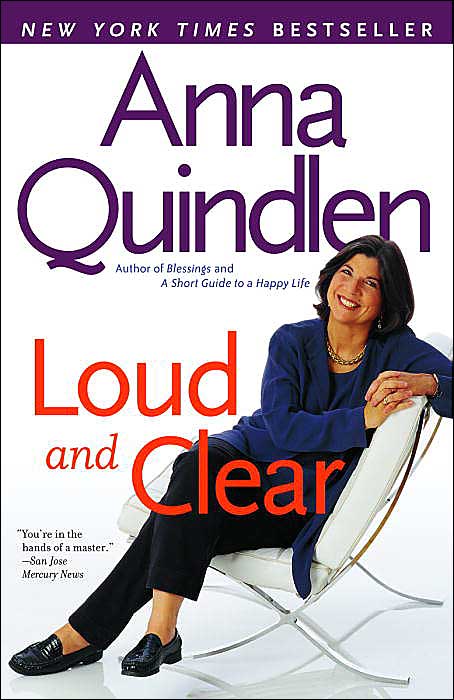
Above is from the preface of Loud and Clear, by Anna Quindlen, Ballantine Books; Reprint edition (March 29, 2005)

B. Below an exceprt from the same book about life - with 3 young children.

Chapter 1 "Heart" "Good-Bye Dr. Spock":

"But the biggest mistake I made is the one that most of us make while doing this. I did not live in the moment enough. This is particularly clear now that the moment is gone, captured only in photographs. There is one picture of the three of them sitting in the grass on a quilt in the shadow of the swing set on a summer day, ages six, four, and one. And I wish I could remember what we ate, and what we talked about, and how they sounded, and how they looked when they slept that night. I wish I had not been in such a hurry to get on to the next thing: dinner, bath, book, bed. I wish I had treasured the doing a little more and the getting it done a little less."


Thursday, April 19, 2007

Virginia Tech Tragedy - Resources, Responses - "Learning Cures Sadness" (90 seconds MP3)

1. Request from Sally Gilbert of TLT Group for resources in response to the tragedy at Virginia Tech this week; and
2. "Learning Cures Sadness" - Response from Steve Gilbert

Also see: Link to Web page for FridayLive! special session "Staying Sane - in Insane Times."

Email message from Sally Gilbert:
"We're all struggling to understand what happened at Virginia Tech this week and to do whatever we can to support our friends at Virginia Tech...

"We've started a web page to compile resources to share and which might also be helpful to others. http://www.tltgroup.org/VaTechresources.htm

"If you have something you'd like us to add to the webpage, please send it to Sally Gilbert
sallygilbert@tltgroup.org"

Or add your contribution (comment, question, reference or resource) as a comment to this posting - click on "comments" at the bottom of this posting, below. You do NOT need to have a Blogger account. You are welcome to add your name and contact information if you wish.

Steve Gilbert's response to Sally's request: "Learning Cures Sadness"
Here is one of my favorite quotations - about "Learning Cures Sadness." As one of Merlyn’s responsibilities for raising the boy who is destined to become the king of England, he advises the young King Arthur about coping with frustration and sadness. From T. H. White's The Once and Future King, Berkeley Medallion Edition, July, 1966, page 183.

For audio-narrated QuickTime version click here.
(Click here to download free QuickTime player.) There may be some delay while the file downloads. If nothing happens AFTER the slideshow appears on your screen, find and click on the "play" button beneath the slider control - beneath the slides.

See below for other media options. Here's the text:

"'The best thing for being sad,' replied Merlyn, beginning to puff and blow, 'is to learn something. That is the only thing that never fails.

You may grow old and trembling in your anatomies, you may lie awake at night listening to the disorder of your veins, you may miss your only love, you may see the world about you devastated by evil lunatics, or know your honour trampled in the sewers of baser minds. There is only one thing for it then--to learn.

Learn why the world wags and what wags it. That is the only thing which the mind can never exhaust, never alienate, never be tortured by, never fear or distrust, and never dream of regretting. Learning is the thing for you. Look at what a lot of things there are to learn--pure science, the only purity there is. You can learn astronomy in a lifetime, natural history in three, literature in six. And then, after you have exhausted a milliard lifetimes in biology and medicine and theocriticism and geography and history and economics--why, you can start to make a cartwheel out of the appropriate wood, or spend fifty years learning to begin to learn to beat your adversary at fencing.

After that you can start again on mathematics, until is it is time to learn to plough.'"


Choose Among 5 Versions:
These were produced almost automatically via LecShare Pro - which synchronizes MS PowerPoint slides with audio files - and YouTube and iTunes. Full audio is less than 5 minutes.

QuickTime Version (Click here to download free QuickTime player.)

  • You may experience some delay while the file downloads - time depends on speed of your Internet connection, etc.

  • If you do not see a slider control just beneath the slides, try a full-screen view option in your browser.

  • The slider control permits you to start/pause, skip a slide, etc.

  • If nothing happens AFTER the slideshow appears on your screen, see if there is another "play" button beneath the slider control. If there is, click on that "play" button to start the slideshow!

  • Just right of the slider control a slide title is usually displayed. If you click on that title you should see a list of all slide titles. You can click on ANY of those titles listed. Doing so will re-start the slideshow at the slide with the title you have selected.

YouTube Version (VERY similar to QuickTime version!); runs automatically on the YouTube Web site.

HTML Version

  • To see all of the controls and options you might need to scroll down or you may need Full Screen view from your browser.

  • You can and must control movement from one slide to the next or previous.

  • To hear the audio for a slide, click on "play".

  • This version may be the most useful for those who are dependent on using screen reader software.

MP3 Version

  • Audio only. Useful for creating podcasts.

  • You may experience some delay while the file downloads - time depends on speed of your Internet connection, etc.

MS Word Version

  • No audio

  • Suitable for printing - pictures of each slide.

  • Includes "lecture notes" - if any - embedded within PowerPoint slides by leader/presenter

  • Intended for reference or for writing notes while listening/watching some other version. Can write notes online via MS Word (or browser editing software?) or can print and write notes by hand.

  • Note that the images of each slide that appear in the Word document are pictures. They cannot be edited in the same ways that PowerPoint slides or Word text documents can be edited. Distributing only this version may ensure that any user will include citations, copyright info that appears on original slides and not change any slides - avoids potential for distortion or misrepresentation.

Friday, April 13, 2007

"Attending Genocide Conference" (4.5 Mins - Video)


Please watch/listen to "Attending Genocide Conference." (4.5 Mins - Video)


[Photo copied April 13, 2007, from "Portfolio - Being Human - Philosophy of Teaching: This, Too, Is Part of Being Human" by Kathleen Z. Young, Ph.D., Department of Anthropology, Western Washington University,

http://pandora.cii.wwu.edu/showcase2005/young/portfolio.htm]

This was one of first, and most provocative, responses to my request for examples of "clips" yesterday. It is embedded in a Website and related "portfolio" of materials that provide an excellent model for one way to extend the possibilities of a brief clip. By sending this sample I hope to prompt more of you to share clips and suggest different ways of using them.

This simply constructed videorecording is disturbing, perhaps profound. Young describes the atrocities of Srebrenica and her commitment to "not looking away." She ends with a hopeful explanation of new international responses to genocide. This clip is presented as her response to "Why did you take your students with you to the International Genocide Conference in Sarajevo?"

Please watch/listen to "Attending Genocide Conference" at:

http://pandora.cii.wwu.edu/showcase2005/young/showcase3.htm

First click on the above URL, then to begin this videorecording, click on the "play" (left-most) button on the control panel that appears beneath the viewing screen as shown here.

You may also need to increase the audio volume or listen carefully. It is worth it!


Please don't be intimidated by this example. We need to find a wide range of useful models. Far below in this message, I include links to a few other valuable examples that are much simpler. I hope more of you will be encouraged to share your first modest efforts! We need the LTA approach to 5-minute clips and hybrid workshops!

In four and a half minutes Kathleen Z. Young of Western Wash. U. calmly describes how she came to take a group of "… students to travel to Bosnia with me to attend an international conference on genocide in Sarajevo and participate in the excavation of a mass grave and the Muslim mass funeral and reburial of 600 of the 8,000 Bosniaks killed in the United Nation's 'safe haven' of Srebrenica in 1995."

You can go deeper into this experience and learn more about Young's teaching and the responses of some of her students by visiting other parts of this extraordinary Web-based "portfolio".

Student Reflections (about Genocide Conference trip - includes photos):

http://pandora.cii.wwu.edu/showcase2005/young/student_reflections.htm

Student Comments about Young as teacher:

http://pandora.cii.wwu.edu/showcase2005/young/student_comments.htm

Student Essay - text + photos - "Because I was There" - response to trip to Genocide Conference:

http://pandora.cii.wwu.edu/showcase2005/young/becauseiwasthere.htm

Excerpt from Young's website:

"The first time I taught the class on Islam and Conflict in Europe it was as an unpaid labor to prepare interested students to travel to Bosnia with me to attend an international conference on genocide in Sarajevo and participate in the excavation of a mass grave and the Muslim mass funeral and reburial of 600 of the 8,000 Bosniaks killed in the United Nation's 'safe haven' of Srebrenica in 1995. From the conference in Bosnia, the students traveled with me to Den Hague in The Netherlands and attended the trial of the Slobodan Milosevic. Students went with me to the new International Criminal Court, also in Den Hague, to meet with a judge on the new court and discuss the importance of anthropology in ending the impunity of the rogue actions of leaders committing genocide and crimes against humanity and helping the weak and victimized have a forum to speak their truths."

_______________________________________________

Comment added to TLT-SWG Blog Posting April 12, 2007

From Karen Casto, Director, Center for Instructional Innovation, Western Washington University, Karen.Casto@wwu.edu

At the Center for Instructional Innovation at Western Washington University we have been using the concept of short videos as part of our innovative teaching showcase published on the web each year since 1999. In past years the showcases have a theme, with last year's being "educating global citizens". We create both written and video materials for these showcases and our goal is for both faculty at our institution and faculty from around the world to be able to use this resource.

Last year for the first time we used Google to host our videos, in part because we had an ever changing campus video environment, but mostly because Google provides statistics for each video, and also allows users to download the videos, search for appropriate videos, and use them for their own purposes.

The two highest rated and most viewed and downloaded, according to Google, from last year can be seen at:
Teaching Russian [2 Mins 53 Seconds - teaching basic Russian by speaking (almost) only Russian from very first class session + other suggestions - SWG]

Inviting class to accompany teacher who was invited to give a paper at international conference about/at memorial to srebendsa genocide; description of what happened at the conference and roles and responses of students
Attending Genocide Conference

The full showcase can be seen at 2005-06 Innovative Teaching Showcase

http://pandora.cii.wwu.edu/showcase2005

These videos are all made here at the teaching/learning center, mostly by students.

Thursday, April 12, 2007

Share 5-Minute Clips, 5-Minute Hybrid Workshops

Please add a comment to this posting in which you provide a URL (Web address) for one or more 5-minute clips and/or 5-minute hybrid workshops. (Definitions below.)

Please add at least one sentence for each example in which you describe it. Please add your name and email address and any other contact info you would like - including times when you would prefer NOT to be contacted about this! If you have any trouble adding a comment, or simply prefer an alternative, send your info to gilbert@tltgroup.org

Thanks for your help!
Steve Gilbert

HERE ARE DEFINITIONS FROM HOME PAGE FOR THIS TOPIC
For more examples in many formats/media and other resources go to:
http://www.tltgroup.org/TLT5.htm

"5-Minute Hybrid Workshops" & "Clips"
Working Definitions - As of April, 2007
Use of term "hybrid" here is confusing to some. We welcome clearer 1 or 2 word alternatives.

Clip vs. Workshop
A "clip" is a pre-recording produced as a single computer file. It may include a variety of media elements: sound, images, text, etc.
A "5-minute hybrid workshop" is the combination of a "clip" AND some other files, activities, documents, ... intended for use together with a group of people in 5 minutes or less. (Of course, some groups may find the materials so fascinating that they extend the session well beyond 5 minutes!)

5-Minute Hybrid Workshops

  • Less Than 5 Minutes
    When run without interruption, the pre-recorded elements require less than 5 minutes!
    [Note: The person "playing" the pre-recording may be so intrigued by some references that she/he may interrupt the session to examine those items more closely. Such activities may quite legitimately extend the required time well beyond 5 minutes!]

  • Faculty/Professional Development (and the improvement of teaching/learning in specific courses)
    Its purpose is to support faculty development, professional development, teaching, or learning.

  • Combination
    It combines SOME of the following: media, modalities, resources, plans, and activities.
    It can have both synchronous and asynchronous components.
    Example A: Entirely synchronous. Within a face-to-face meeting, use of a 2-minute pre-recorded explanation of a technique in conjunction with 1 minute of silent thoughtful reflection and 2 minutes of open discussion.
    Example B: Synchronous + Asynchronous: Within a synchronous online meeting, "play" a 2-minute pre-recorded introduction of a new topic, ending with clear instructions about how to submit questions and comments via a blog for an assignment that is intended to require each student to continue or extend his/her thinking about this new topic for a few more minutes whenever convenient within the next week.

  • Individual or Group
    It may be intended for independent individual use or for group activities such as workshops. For example, a recording of an audio-narrated set of PowerPoint slides could be designed to introduce and demonstrate a single skill to a faculty member working alone in his/her office. Alternatively, an audio-narrated set of PowerPoint slides could be designed to explain a simple teaching strategy, describe one or two examples of its use, and suggest several questions for discussion among a group of faculty during a small portion of a departmental meeting.

  • Internet-Accessible Components
    It includes at least some components available via the Internet.

  • Low-Threshold
    It is to some extent an LTA [Low-Threshold Activities/Application]

Tuesday, April 10, 2007

New Learning Spaces: Health Care Embraces Electronic Info + "Bodies...the Exhibit "+ Valparaiso Univ. Lab

While pornography may be the industry to most rapidly adapt new information technologies, the health sciences are often the academic disciplines to do so. If you want to find some examples of innovative integration of technology, physical space, and virtual realities, look into medical education - whether in colleges and universities or hospitals. E.g., visit "Bodies...the Exhibition" when it comes to your city [see below] or see silent slide show (< 2 minutes) about Valparaiso University's Virtual Nursing Learning Center, and read the article excerpt below about Integrating Electronic Medical Records.

VIRTUAL NURSING LEARNING CENTER
This slide show ends by taking your browser to a Web page where you will find more info about this fascinating learning/teaching space, including a longer, full-motion narrated video about it. Click here: http://www.tltgroup.org/TailoredWebsites-gigs/Valpo/VVNLab.htm

BODIES...THE EXHIBITION
"Bodies... the Exhibition" - slightly controversial mix of art and anatomy education - human cadavers extraordinarily preserved, displayed, annotated, and explained. For more info, see: www.bodiestheexhibition.com . I saw a version of this exhibit in Chicago a couple months ago and was astonished, fascinated, educated, and exhausted. I need to go at least once more.

INTEGRATING ELECTRONIC MEDICAL RECORDS
"The electronic medical record is the most important single development helping to usher in the Era of No Excuses in modern medicine. It is an age in which clinical decision-making, physician performance and patient outcomes are increasingly transparent; patient safety is mechanized; and the once-secret medical chart is sometimes open to contributions from the patients themselves.

"Electronic medical records make confusing and physically unwieldy masses of data instantly available, portable and searchable -- altogether more useful than when the information was stored on paper. Computer-accessible records have the potential to save the cost-strangled American medical system billions of dollars in waste, repetition and error. They may also prove to be essential tools of research, allowing scientists to examine patterns of medical practice, drug use, complication rates and health outcomes."

Excerpt from: "VA Takes the Lead in Paperless Care - Computerized Medical Records Promise Lower Costs and Better Treatment," By David Brown, Washington Post, April 10, 2007; p. HE01
VA Takes the Lead in Paperless Care - washingtonpost.com

Thursday, April 05, 2007

"Touch of Greatness" - Video about teacher; "Geranium on the Windowsill Just Died...."

"Students are turned on by greatness and bored by mediocrity."

"Children who get early exposure to great art, great music, great literature, don’t run away from it - ever in their lifetime - it’s like a friend."
- From preview clip of PBS movie, “A Touch of Greatness.”
Preview and 2 other BRIEF clips from PBS documentary film about teacher Albert Cullum - teacher, author who died in 2003 - See this URL available as of 4/5/2007 at:
http://www.pbs.org/independentlens/touchofgreatness/teacher.html

Cullum is perhaps best known for his book: The Geranium On The Windowsill Just Died But Teacher You Went Right On (written 1971, reprinted: Harlin Quist Books, 2000)


Tuesday, April 03, 2007

Watch for Cell Phones on Campus! Why?

8 to 12 year olds are using cell phones. Wake Forest Univ. students can check their laundry status via cell phones.

See below for more... including "5. Class resources like a mobile periodic table at your fingertips" from list of"...top 20 reasons" student should "...join MobileU" [cell phone system at Wake Forest]

What's the difference between a cell phone, a pocket pc, and a clicker?

A. $100
B. 1 year
C. 2 ounces
D. Students' dependence
E. Faculty attitudes
F. All of the above

NOTE:
  • Pocket PC = very small handheld computer; over-developed PDA = Personal Digital Assistant; Handheld device; Palm; etc.
  • Smart Cell Phone = whatever works on latest cell phone models!
  • Clicker = Personal Response System; students individually and anonymously answer multiple choice questions in class

Following excerpt is from "Three Dads, a Kid-Oriented Cellphone Service" By Kim Hart, Washington Post Staff Writer, Washington Post, Monday, April 2, 2007; p. D02
URL as of 4/3/2007: http://www.washingtonpost.com/wp-dyn/content/article/2007/04/01/AR2007040100683.html?sub=AR

"Daniel Neal scoffs at the notion that children are too young for cellphones.

'Kids are using more advanced mobile devices than even their parents,' said Neal, co-founder of a new cellphone service geared specifically toward 8- to 16-year-olds. 'They're adept. They're swimming in technology, and they're comfortable using it.'

"...it is the 'tween' market of 8- to 12-year-olds that is considered to the be one of the last frontiers for wireless companies, according to a 2006 study by the Yankee Group, a market research firm. More than half of the 'tween' population will be wireless users by 2010, the study predicted.

"Most of the 'tweens' already using cellphones are on family plans -- the earliest attempts by wireless companies to capture business. In the past two years, a handful of companies entered the 'tween' market. Disney, LeapFrog, Verizon and LG rolled out kid-friendly phones with parental controls.

Following is from Wake Forest University Website about it's Mobile University plan
URL as of 4/3/2007: http://mobileu.wfu.edu/?page=spring2006details

"MobileU Spring 2006

Registration is open NOW for spring enrollment in Information Systems’ MobileU™ pilot program. Join! If you know nothing about technology – or know everything – MobileU is for you! As a member of the Wake Forest community, you have the opportunity to join in one of the nation’s first Pocket PC phone pilot programs. See for yourself what everyone is talking about!

Use the Mobi to lead your sorority more effectively. Keep in touch with your teammates about changes in practice or game strategies. Prepare for the technology you’ll be expected to use in the real world. Or, just love it as a phone!

The $279 cost includes the Cingular 8125 (Mobi), warranty, insurance, free 1 GB storage card, PLUS 20% discount on Cingular service.

The top 20 reasons YOU should join MobileU:
20. Free Wi-Fi!
19. 1 GB Storage card
18. No service plan contract!
17. 20% off Cingular service plans
16. E-mail on the go
15. Instant messaging on the go
14. Track the campus shuttle arrival time
13. Check laundry from anywhere
12. Unlimited mobile-to-mobile minutes
11. Enhanced cellular coverage on campus
10. Mobile versions of Word, Excel, PowerPoint Viewer, Campus Map, WIN, and more!
9. Leave virtual messages in campus buildings for others to find
8. Use it to store your music files
7. It’s a camera!
6. It’s a video camera!
5. Class resources like a mobile periodic table at your fingertips
4. Mobile class schedule that turns off the ringer when you’re in class
3. Insurance through May, 2008
2. Great on-campus support team
1. And oh yeah, it’s a cool phone!

Tuesday, March 27, 2007

Top 10 Assessment Objections [5 min audio attached, slides available]

Top 10 Objections to Assessment in Higher Education
And how to think about and respond to them! March 30, 2007

Join 2 Steves of the TLT Group 2pm EDT FRIDAY March 30

\
Any of these sound familiar?


• Just tell me the least I can do to keep the assessment advocates off my back.
I've never seen an assessment that was worth the time and money.
• Outsiders use assessment to grab power - to control people, programs or budgets
• Studies are a waste of time. The findings don't change anyone's conclusions.
• Setting assessment-oriented objectives will distort what we do best in this program
• It's too soon for assessment. Let's wait until things are running well
• Assessment may be OK in theory but I don't have time.
• Assessing costs? Just an excuse to cut budgets and jobs!
• More assessment? We already grade students and have a student course evaluation system.
• By the time we get any results from an assessment, they'll be obsolete.
• I already know more about my courses and students than any 'assessment' can tell me.


For free-but-required advance registration, go to:
http://www.tltgroup.org/Registration/Registration/Frid aylive.htm

For an EXCELLENT introduction, examples, and some additional resources, click here.

Direct link to 5-minute preparatory, introductory "workshop" - QuickTime

To help us plan a more successful session this Friday, please take 2-3 minutes to fill out this survey. Tell us which objections should be the focus of our session!

To take a BRIEF survey, click here

What We Will Do on March 30

We'll offer a variety of resources to help people working on activities where "assessment" can trigger a dangerous discussion, e.g., assessment training, accreditation, student course evaluation, testing programs, personnel evaluation, cost analyses... This FridayLive! session will discuss several techniques for avoiding needless controversy (arguments that can happen even when people actually agree with one another) and for shining a flashlight on real disagreements.


For free-but-required advance registration, go to:
http://www.tltgroup.org/Registration/Registration/Frid aylive.htm

Friday, March 23, 2007

Educational Uses of Second Life (Notes from FridayLive!)

We just had a fascinating online discussion about Second Life and its educational uses in our free FridayLive! webcast series. The session was led by Ilene Frank and Drew Smith of the University of South Florida, and there were tremendous contributions in the chat room by many of the 75 participants.

Here are a few notes I took about educational applications of Second Life that were mentioned in the discussion. I've tried to emphasize functions where Second Life might have an educational advantage over other online formats as well as over feasible face-to-face interactions. Under each item, I've listed a potential concerns that occur to me, concerns that a feedback survey should address.

Each of these items would lead to a cluster of items for use in evaluative or feedback surveys or interview guides that I'm designing for the Flashlight Program. We'll put the survey items into Flashlight Online as a template, once it's ready. (If you post a comment here or send me an e-mail, it would encourage me to finish this up and share it with our subscribing institutions).

1. Lectures (e.g., people who couldn't attend a face-to-face lecture; might be centered in Second Life, or streaming video from a f2f lecture)

  • Compared with a f2f lecture, are listeners more or less likely to be distracted by their immediate environment?

2. Student projects that involve building or creating something

3. Faculty or students creating something that people can walk through or manipulate: something where learning benefits from happening in a simulated three dimensional environment.

  • For various participants, is the simulation real enough and engaging enough to create lasting memories and insights?

4. Both #2 and #3 create an occasion for comparing simulation and reality: that activity has its own educational value. (This might or might not happen in Second Life, but it's an educational opportunity created by these uses of Second Life.)

5. Activities that benefit from the participant's sense of being part of a group or crowd. A sense of "presence" can be an important part of engagement for learning, working meetings, perhaps even lectures.

  • Any down side to this sense of presence, when compared to a competing way of holding the gathering? (more or less group think?)

6. Using setting, physical design, furniture to create a mood that's useful for the particular function

7. Learning a new language and culture by interacting with people from that other culture, perhaps in a simulated environment that mirrors their environment. For learning another language both chat (a slower pace of interaction, where novices don't need to worry about their accents as they learn to think in a new language) and voice chat have advantages.

A question common to all of these uses, especially those that involve student creation of artifacts (buildings, laboratory experiments, garments, devices, etc.): Time and effort are needed to learn to use Second Life to build things. Is there enough payoff from the activity to justify the effort (not just payoff from this project but from other projects that students might create)? Was the initial experience with the activity sufficiently motivating for the learners and leaders to keep doing this sort of thing (and thus get more payoff from the initial experience with Second Life.)

Thursday, March 08, 2007

FridayLive! Google Docs & Spreadsheets [5 min. audio attached; slides also avail]

Join us for FridayLive! Demo/Discussion of Educational Uses of Google Docs & Spreadsheets 2pm EST Friday, March 9, 2007. For free-but-required advance registration,
click here.

For more info, including several alternative versions of the 5-minute intro/prep workshop, and some additional resources and guidelines for using Google Docs,
click here
.
Recommendation: Try Google Docs!! Watch/listen/use the 5-minute intro [preparatory] workshop created by Cindy Russell esp. for this event!


Why bother? Easy to use. Reliable, accessible. Good for joint planning, collaborative work. Many potential educational uses - esp. well-suited for student collaborative projects.

The following lists of features are intended to help you decide how to use this free resource most effectively. Please suggest additional items for these lists of Advantages, Educational Uses, or Disadvantages by clicking on "comments" or "post a comment" just below this posting.

Advantages: Free and relatively easy Web-based tool for creating and collaboratively editing documents online. Resulting documents are similar to wikis, blogs, but easier to edit and share, publish or hide. With Google Docs, previous versions of the document are always accessible and it is easy to see who made which changes. However, the most easily visible version is the aggregation of all previous changes, completely hiding the process by which it was developed. First time users can be assured that they do not need to worry about making mistakes - no matter what they do, the favorite contributions of each collaborator are always still accessible and can be retrieved and displayed elsewhere or re-integrated into the document. It is relatively painless to establish the online account required for active participation. There seems to be no inappropriate use of the info that must be given to obtain the account. Google's financial success makes it likely that documents created by using this service will not disappear and neither will the service.


Educational uses: Many. Especially nice for student teams in which someone is likely to worry that his/her contributions will not be matched by comparable work done by each team member. At any time, anyone who has permission, can easily view previous versions and see who has made which contributions.


Disadvantages: This tool keeps improving but some functions still work with unpredictable delays. The results of some kinds of attempts to change formatting can also be difficult to predict. Many people who begin working on a Google Docs document for the very first time find it a little more challenging than ideal to understand and follow the directions that are automatically sent as part of an invitation to become a "collaborator" on a Google Docs document. Establishing another online account - with user name and password - is required for active participation.


NOTE: MORE DETAIL THAN YOU PROBABLY WANT OR NEED ABOUT ADDING A COMMENT
To be sure we receive your comment, click on one of the options below the box in which you entered your comment. Then type in the letters that you see in the weird script in the most obvious place - the "word verification" box. THEN CLICK ON "LOG IN AND PUBLISH" - DON'T WORRY ABOUT THE "LOG-IN" PART. You do NOT need to have a Blogger account to leave a comment. If you wish to comment anonymously, click in the circle to the left of that option. If you want to avoid getting a Blogger account, but want to indicate who you are, add your name and contact info WITHIN your "comment" and then choose the "anonymous" option.

Thursday, March 01, 2007

Hybrid (Blended) Faculty Development & Professional Development

How can we use some of the new technologies to help meet the increasing need for faculty development and professional development that those technologies are also creating? How can we improve undergraduate teaching and learning?

Hybrid professional development, hybrid faculty development, and hybrid undergraduate courses can be part of the answer.

NOTE: The terms "hybrid" and "blended" are used almost interchangeably. I prefer "hybrid" because the other term implies more complete integration of the parts than is often possible - or desirable.

Hybrid Education: Synchronous and Asynchronous; Face-to-Face and Distance; Virtual and Tangible; Local and (Inter)National; Mixing Media; Using Web 2.0 Options AND older asynchronous options!

Goal: Provide something BETTER than was possible via any of the components ALONE.

-=-=-=-=-=-=---=-=-=-=-=-=-=-=-=-=-=-=-=-=-=-=-=-==-

We know we can't keep up separately. How can we do better together? How can we use some of the new technologies to help meet the increasing demand for faculty development and professional development that those technologies are also creating?

Hybrid-Hybrid Professional Development is part of the answer.

The accelerating pace of development and access to new technologies with educational potential keeps

1. increasing the need and expectation for professional development

2. increasing workload and decreasing discretionary time for faculty and other academic professionals

3. increasing availability of tools and resources that seem likely to help cope with this overload

This collaborative approach to professional and faculty development is based on ten years of work by the TLT Group which began with a focus on intra-institutional multi-role collaboration (TLT Roundtables) and has shifted more recently to focus on inter-institutional collaboration and greater reliance on WebCasts, Web 2.0 and other Internet-based resources. The TLT Group has learned to develop and offer hybrid professional development by working collaboratively with a variety of professionals from a variety of institutions, because, more than ever, no one can keep up with everything.

The heart of the current model is learning to match what can be done best in face-to-face settings run by local campus professionals with what can be added by providing access to experts and activities who are located elsewhere via online synchronous and asynchronous activities. In particular, we design and support online synchronous live Webcasts including multi-directional audio and a variety of visual displays and interaction options IN CONJUNCTION WITH local gatherings of small groups.

Some of the small groups are linked to the "outside" via a single computer in their meeting room; some participate co-located but with each participant individually logged in within a computer lab; some participate with individual computer connections from their own offices or other campus locations. The success of these ventures depends on effective communication and collaboration among the local leaders and the online presenters. Some of the local leaders can share skills and knowledge that is valuable not only on their own campus but elsewhere too.

Importance or relevance to other institutions: There are so many platforms, operating systems, and software applications available to educators that finding a way through the maze individually can often interfere with the basic need to communicate and work together. The TLT Group has worked over the last ten years to use new technologies and new pedagogies to support, not undermine, communication and collaboration in pursuit of the improvement of teaching and learning. This "hybrid" collaborative professional development has been largely facilitated by offering moderated synchronous, multidirectional, voice, text, and visual applications using web conference interfaces. The synchronous environment is then complimented by asynchronous resources such as blogs, RSS feeds, web pages, and wikis - and whatever other options have emerged recently from Web 2.0, etc.

Monday, February 26, 2007

Students writing their own textbook using a wiki

At Old Dominion University in Virginia, Dwight Allen and his graduate assistants teach over 200 students in "Social and Cultural Foundations of American Education." The course has many sections, some taught on campus, some in a distance learning format.

Allen saw that the textbook was not engaging students effectively, so he decided that, the next term, the students would be assigned to collaboratively create their own text, using the same software used by authors of Wikipedia.

Allen's team provided the chapter headings; students each worked on a different section, writing for other students. Three versions of each section were written and, later, students critiqued the drafts, and voted for the best version of each one. Using their advice, the faculty picked the versions for each chapter; the other versions were also included as supplementary material. All this was done in the first month of the course; after that, the students studied the textbook they'd created, as well as using other elements of instruction: lectures, discussions, readings, and so on.

For more on how the course and writing were organized, click here.
*************************
What you see above is a new addition to our materials on 'Digital Writing Across the Curriculum.'

A little explanation: Writing Across the Curriculum (WAC) is important because writing is the lifeblood of most college courses: when students entering a course can already write well, the instructor has more options for how to teach them, and how to assess what they've learned. When those same students also have skills of digital writing (e.g., creating web sites, using multimedia, writing for wikis and blogs), those options expand even further. That's my hypothesis, and this TLT Group resource gives examples of disciplinary courses that are being taught in fresh, effective ways by using assignments that involve digital writing. Please send me more examples! We hope that our subscribing institutions will use this web site to consider whether, and how, to foster such skills in their students in order to help all departments improve instruction and assessment.

If you like this work, the best way to support it is to urge your institution to subscribe to The TLT Group.

Humor - support service crisis

The parallels between the uses of reading/writing, the uses of campuses, and the uses of computers and the Internet are fascinating. Not only the gains for higher learning are similar; so are the problems. Click here if you're interested in reading a short piece I wrote about that theme several years ago.

Here's a bit of humor on the same subject. This YouTube video clip shows a monk checking with his Help Desk staff about how to use a mystifying new technology, the book. It was passed along to me by my friend Jeffrey Brewster in Brussels. I'm not sure what the original language is (German? Flemish? Dutch?) but the English subtitles are quite adequate. I loved it!

Sunday, February 25, 2007

The Flashlight Approach to Evaluation, Summarized

For a variety of reasons, educators, their units and institutions now often gather evidence in order to evaluate 'stuff'. By 'stuff' we mean tools, resources, and facilities such as course materials, computer software, classroom design, blended courses, distance learning programs, network infrastructure, libraries, ePortfolios, ... By "evaluate" we mean a purposeful gathering of the evidence needed in order to make better choices about what to do next.

These days when people think about evaluation, their thinking often begins and ends with 'outcomes assessment.' But information about outcomes is rarely enough, by itself, to show how to improve those outcomes. (For more on this point, click here.) The Flashlight approach to evaluation is designed to provide the best insights for improving outcomes for the least effort.

The Flashlight approach has a number of elements, of which these are the most important:


1. Activities: Focus on what people do with the 'stuff' at issue. For example, if you want to get more value from personal response systems (some of which are also known as 'clickers'), you first need to discover what faculty and students are actually doing with the clickers. For instance, are the clickers being used to create structured discussion about difficult ideas? to take attendance? to test memorization? Each of those patterns of use (which we refer to as 'activities') will create different benefits, costs, damage...

2. The dark side: Consider people's fears and concerns about the stuff, not just their hopes and goals. For example, if clickers are being used to take attendance, are students sending friends to class with a handful of clickers?

3. Motives, incentives, and disincentives: Value is created by the way people use stuff. So the best clues for increasing that value come from learning why people use the stuff as they do. For example, if you do a workshop on the value of using clickers for conceptual learning, and 30% of the participants don't start using clickers that way, you should investigate the reasons. It might be rooted in their personal approaches to teaching, their disciplines, your training, reactions of students, their facilities, ... No matter what you discover, it's almost always going to be useful in helping you figure out whether and how to get more value from clickers.

4. Education is not a machine: Even when the same faculty member teaches two sections of the same course, and has taught them for years, what students do and learn will differ. Add clickers, or any other technology that increases options for faculty and students, and that variation will probably increase. That's one reason we emphasize unique uses perspective for evaluation, and not just uniform impact approaches.

5. Collaboration: Whose choices influence how the stuff is used? Whose choices could change how the stuff is used? Those are the people who should be involved in helping design your study. If you need help in gathering data (e.g., getting good response rates to surveys), then they can help. They can also help you make sure that your questions and language are clear and compelling.

6. Start evaluating now: To improve outcomes (including costs), change activities. (Buying new stuff is just a means to change activities). And it's always the right time to begin studying an activity. So start evaluating now.
For example, if you're interested in using clickers to foster conceptual learning, start evaluating conceptual learning (including faculty development) now, whether or not you're using clickers yet, whether or not you're experienced in their use yet, whether or not you're considering replacing one kind of clicker with another. For example, if you are considering buying new stuff, your findings can help you
* choose products;
* remove barriers to effective use even before the technology becomes available, and
* provide baseline data for measuring the impact of the new stuff.
In short, whether or not it's time to buy, develop, or replace stuff, it's always time to begin studying activities that use, or that would use, that stuff.

The whole Flashlight Evaluation Handbook is designed to flesh out these and related ideas using examples and specialized guides. The TLT Group can also provide coaching (send us your draft plans and we can talk), collaborators in doing such studies, or we can even do them for you. So take a look at the Handbook and contact us if you'd like to talk (301-270-8311; flashlight@tltgroup.org).

PS. If your institution is a subscriber, feel free to use this summary for workshops. If your institution is not yet a subscriber, we would appreciate it if you would ask permission to use this material.

Choice and Happiness

How much does our happiness depend on on what happens to us (win the lottery or have your limbs amputated?), and on choices we make about our lives? Dan Gilbert gave this startling talk on both topics, illustrated with some provocative psychological studies:
http://www.ted.com/tedtalks/tedtalksplayer.cfm?key=d_gilbert
Gilbert's talk is certainly making me take a second look at decisions about which I tend to agonize, and about the role of choice in life, and I'm going to read his book Stumbling on Happiness. How many choices do you face? Does your job involve giving other people choices in life? If you have time or inclination to watch only one of the talks described here, watch Dan Gilbert's and please post a comment about what you make of its implications for your life and work.

Two other TED talks dealt a subset of Gilbert's topic, just having to do with choices in products and services.

Malcolm Gladwell talks about recent research that has led food companies to create many more choices in grocery stores: so many different kinds of mustard and vinegar, for example.
http://www.ted.com/tedtalks/tedtalksplayer.cfm?key=m_gladwell

But even though research indicates that companies can sell more mustard if they offer these choices (because there is no 'ideal mustard', at any price: different folks like different kinds of mustard), do such choices make us happier? Barry Schwartz uses cartoons to explain why he thinks these choices are making us unhappier:
http://www.ted.com/tedtalks/tedtalksplayer.cfm?key=b_schwartz

To repeat: if you have time to watch only one, watch Gilbert's. If you know anything about Zen Buddhism, tell us how this relates, or doesn't, to that or to other religions. In the meantime, I may start flipping coins as a way of making tough decisions about life!

Friday, February 09, 2007

The Paradox of Risk

Steve Gilbert and I have been working with a major university system on issues of strategic planning. Their planning teams have developed a huge list of imperatives for institutions and the system office, in order to improve teaching and learning with technology. I wondered how they would choose among those priorities: like everyone else, they have only limited funds, and even more limited time and attention. Choice is crucial, even when all the alternatives are wonderful, important and interdependent.

It reminded me of an evaluation that was done of the Fund for the Improvement of Postsecondary Education (FIPSE) when I was a staff member there. I think this was around 1979. The final report said that most FIPSE projects succeeded so well locally that they continued in operation at least 2 years after funding ended, and that they influenced something like a dozen other institutions, too. At our first staff meeting after these findings were announced, most of us were over the moon. But my colleague Alison Bernstein (now with the Ford Foundation) was disturbed. 'We're supposed to be a risk-taking funder,' she warned. 'This may mean we've been too conservative in choosing among proposals.'

I thought about that. Most seed grant programs had success rates far lower than FIPSE's: 10-20%, not 80-90%. Authors had written influential books about how likely innovation in higher education was to fail. So why were these FIPSE projects succeeding so often? The answer seems relevant to strategic planning today.

FIPSE's review process attracted people to submit their best ideas. The review process winnowed out almost all of them: less than 5% were funded. And 'apples' were always compared with 'oranges': which ideas were most learner-centered, cost-effective and capable of far-reaching impact?

I think the resulting ideas were so powerful that people inside and outside the author's institution would say, "Normally when you propose something I don't pay much attention. But this idea is different. It's so important that we can't let it fail. How can I help you?" FIPSE-funded ideas usually attracted resources and support far beyond what FIPSE had awarded. I remember talking with another institution that had adopted an idea pioneered by a FIPSE grantee, "Once we realized that it was possible to do that, our institution couldn't not do it."

Institutions and systems need ways to seek out ideas, from inside and outside. Sift them for the ones that are so important, and so potentially rewarding, that a coalition of support is easy to put together. A few ideas like that, successfully implemented, can help develop momentum and support for a second generation of improvements. Like FIPSE, it's also important to use some degree of external review to help sift ideas: external review can help the institution see if the ideas really are significant, and remove some of the political risk of making such choices purely with insider input.

What do you think? Wonderful idea? Impractical? Wrong-headed?

Thursday, February 08, 2007

"Take 5 for Teaching" Five-Minute Workshops - Example, "The Last Day of Class"


Provided by Todd Zakrajsek, Director, Faculty Center for Innovative Teaching (FaCIT), Central Michigan University. EMAIL: zakra1t@cmich.edu


Several examples available at:
http://facit.cmich.edu/whats-on/archive.html

[5 MINUTE VIDEO] "The Last Day of Class"
Need QuickTime or similar player.
http://facit.cmich.edu/videos/tfft-last-day.html

To what extent is it useful to have this available as a 5-minute video recording?
vs. Audio recording?
vs. Text description?

Which combinations of video, audio, text, etc. and a possible face-to-face session would be especially useful? For which purposes?

List of main points from video presentation:

  • Food
  • Undergrad research possibilities
  • Review syllabus
  • Link course content to life
  • Greet students by name
  • Ask for student feedback
  • Discuss what current students would write to students who take course next term
  • Discuss next semester
  • 3 most important things learned in course
  • Describe what TEACHER has learned
  • Self-addressed stamped envelopes for students - encourage later feedback
  • Course-evaluation survey at BEGINNING of session
  • Resist urge to cram in more topics
  • Discuss purpose of course and hopes

Monday, February 05, 2007

Imagine Adding Face-to-Face to Online Educ. - Thought Experiment


Exciting "thought experiment":
Suppose all higher education were conducted online.
Now imagine how and why you would ADD face-to-face meetings.
  • In what ways could you improve online education by creating new hybrid or blended options?
  • What strategies would you recommend to teachers,students in this new combined environment?
  • How could you best take advantage of both synchronous and asynchronous interaction?
  • What different media might you use?
  • In what ways would you encourage, support, or prevent students from multi-tasking?
  • How does the concept of "band-width" influence your choices?

This activity was suggested by Doug Eder, Director of Univ. Evaluation, Arizona State Univ. during a telephone conference call 1/30/2007 involving about a dozen experts in various aspects of faculty and professional development for college teaching and learning.

Listen to Eder describe this idea informally via MP3 .

Image Maps - 2 Instructional Examples [MP3 Audio 40 secs]


Two samples of instructional use of image maps from John Prusch of Excelsior College:
1. For a course in phonetics, several linked Web pages enable the learner to HEAR sounds associated with phonetic symbols in a variety of configurations:
http://hctv.humnet.ucla.edu/departments/
linguistics/VowelsandConsonants/course/chapter1/chapter1.html

2. A Page from the Babylonian Talmud: "Click on any portion of the …image, …[for] when and where the text was composed, its contents and purposes, …"
http://www.ucalgary.ca/~elsegal/TalmudPage.html

Prusch comments: "Image maps are an under utilized but quick and easy tool to use in teaching. They provide a simple means for explaining, illustrating, or annotating difficult concepts, processes, and examples not only with text but also with images, video, and sound recordings." MP3 Audio Version

Saturday, February 03, 2007

Help! Need webcast telephone connection!

Need 2-way link between Webcast and telephone conference call.
  • Prefer software interface solution (e.g., linking Skype phone call with Webcast connection INSIDE a computer).
  • Hardware device linking computer, phone and headset would be OK, but Andrea PCTI device is inadequate due to local radio interfeernce.
CHALLENGE
Some people who participate in the Webcast cannot use a headset connected to a computer for audio participation, so they need to be able to use a telephone to connect to a conference call to hear and be heard.

GOAL
  1. Run live Webcast with 2-way link to telephone conference call.
  2. This link must be monitored and controlled by someone via a headset.
  3. Everyone who is participating in phone conference call must be able to hear everything that is "broadcast" by the Internet Webcast.
  4. Each person who is participating in the phone conference call must be ABLE TO BE heard by everyone who is participating via the Internet in the Webcast. This person needs to be able to click on the microphone to speak option in the Webcast when someone in the telephone conference call wants to speak and be heard by others on the Webcast.

Thursday, February 01, 2007

Using video case studies for faculty development

MERLOT is working on including some stories, thanks to a FIPSE grant for a project called ELIXR that is just getting underway.

Some years ago I wrote a report on the use of video stories for faculty development:

A group of us had spent a day watching videos and looking at multimedia web sites for faculty development (the few that existed in 1995!) . We concluded, among other things, that we had seen two types of materials, both of which could be classed as stories:
  1. Stories intended to help the user visualize a way of teaching and become interested in trying it ("explanatory selling stories")
  2. Stories intended to give the user, interested in a particular way of teaching, the vicarious experience of getting into trouble so that the reader (usually in a seminar with others) could learn how to identify and analyze that type of problem, and figure out how to deal with it (e.g., how to turn it into a teachable moment). ("provocative case studies")

These kinds of stories, especially the provocative case studies, are very important for helping faculty use technology to alter the nature of their teaching, but I've seen almost none in use. The TLT Group has developed a few text case studies of this type (if you're at a TLT Group institutional subscriber, use the regular username and password if you'd like to see this subscriber-only material and let us know how we can add to it!).

The University of Victoria in Canada has a DVD of such stories called "Critical Incidents in Teaching with Technology." The DVD is intended for use in faculty development. Has anyone seen and used it?

Has anyone seen and used any other faculty development materials designed to help faculty learn how to get out of trouble that new pedagogical approaches (using technology) might get them into?

Wednesday, January 31, 2007

"Time is the only thing we have" Chickering on Balance, Intentionality [approx. 1 minute]

How Chickering tries to balance personal, family, professional commitments and self-nourishment by being very intentional about his own time. Response to one of opening questions on 1/30/2007.

MP3 File

Chickering is currently Special Assistant to the President, Goddard College. He recently co-authored Encouraging Authenticity and Spirituality in Higher Education, and was co-author of the widely respected and widely used Seven Principles of Good Practice in Undergraduate Education... and many other important publications.

Tuesday, January 30, 2007

Chickering on Wonderful Wife, Marriage - 1/30/2007 [3 Mins. MP3]

A wonderful personal, family, and professional relationship! Chickering's closing response to "New Year's Resolution" questions on 1/30/2007. Value of working hard together on a marriage of 50+ years!

MP3 File

Chickering is currently Special Assistant to the President, Goddard College. He recently co-authored Encouraging Authenticity and Spirituality in Higher Education, and was co-author of the widely respected and used Seven Principles of Good Practice in Undergraduate Education... and many other important publications.

Cherish Failure... Chickering Response [30 Secs. MP3]

Cherish failure, be wary of success, suggests Art Chickering in response to "New Year's Resolution" questions on 1/30/2007.

MP3:
http://archive.tltgroup.org/2007/NewYearsResolutions
/ChickeringCherishFailure20070130.mp3

Chickering is currently Special Assistant to the President, Goddard College. He recently co-authored Encouraging Authenticity and Spirituality in Higher Education, and was co-author of the widely respected and used Seven Principles of Good Practice in Undergraduate Education... and many other important publications.

Personal/Professional Perspective: Chickering Resists Dichotomy [Approx 1 minute MP3]

Art Chickering resists the dichotomy of personal & professional life. He also responds to "New Year's Resolution" questions on 1/30/2007 by citing Robert Frost, Two Tramps in Mud Time, last stanza:

But yield who will to their separation,
My object in living is to unite
My avocation and my vocation
As my two eyes make one in sight.
Only where love and need are one,
And the work is play for mortal stakes,
Is the deed ever really done
For Heaven and the future's sakes.

Full text of poem (as of 1/30/2007) available at:
http://www.etymonline.com/poems/tramps.htm

Chickering is currently Special Assistant to the President, Goddard College. He recently co-authored Encouraging Authenticity and Spirituality in Higher Education, and was co-author of the widely respected and used Seven Principles of Good Practice in Undergraduate Education... and many other important publications.

Monday, January 29, 2007

A Cyst the Size of a Gerbil - Back Surgery Excuse & Web 2.0

Here is my "genuinely lame" excuse for falling behind on email and other activities during the past 6 months: almost-emergency back surgery.

I'm just beginning to catch up. If you have something that I should have done or responded to, please send a copy to Sally Gilbert (sallygilbert@tltgroup.org) before she leaves for some well-deserved vacation time in Peru in 2 weeks!

Sally and I are proud of our innovative use of Web 2.0 as described in the PPS below.

Thanks for your patience and support.
Sorry that I couldn't send individual messages to everyone I know!
Nice to be back.

Steve
1/31/2007

-=-=-=-=-=-=-=-=-=-=-=-=--=-=-=-=-=-=-=-=-=-=-==-=-
A cyst the size of a small gerbil was removed from my spine on January 9.

For the past six months I had been like a frog who hasn't noticed that his pond is really a saucepan heating up very slowly.[1] The pains, twinges and tingles in my left leg continued to increase gradually and erratically in spite of improvements in the ergonomics of my work life, excellent physical therapy, and medical advice. Even though my pains kept me from participating fully in family activities on Thanksgiving and Christmas, and I was missing more work time, I didn't imagine anything really serious was going on.

I had joined the large club of post-middle-age people who joke about their chronic back problems.

But on the morning of January 3 I had an MRI, and by lunch time the test results cancelled my membership. The next few days centered on medical tests, hospital visits, and appointments with doctors - culminating with two hours of almost-emergency surgery on the 9th.

I was able to go home on the 10th, and by the next day the pre-surgery pain and side effects had vanished almost completely. January 15 was the day of my real reprieve: positive post-op office exam and a voice mail message reporting that all pathology tests were negative. I'm still coping with the after-effects and side-effects of significant surgery - especially all the anesthetics and drugs, but even the incision pain is dramatically less than what I had been living with during November and December.[2]

For the past twenty years, I've had a typical variety of occasional borderline danger signals from routine medical exams. Each time the recommended follow-up tests revealed that I did NOT have the potential illness. I became complacent about minor symptoms and inconclusive test results. I wasn't prepared for real medical problems - for unavoidable evidence of my own mortality. Almost 2 weeks since the surgery, I'm just beginning to grasp - emotionally as well as intellectually - this new lesson: that all the best preventive efforts cannot avoid the cumulative effects of aging.

So, now I'm hoping to join - slowly - some of those other large clubs of post-middle-age people who share complaints of pains and maladies. And when I do, I hope my membership can be long and undistinguished. Of course, I've become a fanatic about posture, ergonomics, exercise, and other ways of avoiding back problems. And I'm more committed than ever to daily walking outdoors.[3]

Our family doctor keeps reminding me that these infirmities beat the alternative. All things considered, as he says, it's better to be on the right side of the grass.

I'm more grateful than ever for Sally. She is a wonderful health problem partner - as well as wife, mother, and professional. And I'm grateful for the support of many other friends, colleagues, and family members.

SteveG

PS: Scary News (no longer applicable):
If untreated, the continued growth/pressure of the facet cyst that was fully removed "might" have caused permanent nerve damage with serious consequences - within another few weeks.
"synovial facet cyst" http://www.neurosurgeon.com/conditions/synovial.html

PPS: Web 2.0 Innovation
Second day home from hospital, Sally inspected the incision on my back and tried to describe it to me. She asked to use my Treo 650 cell phone to take a photo so I could see.
I put the photo of the incision on a Web page along with a photo of me doing a Sudoku in the hospital bed. I emailed the photo and the URL to a helpful Surgical Coordinator.
Viewer discretion advised: http://www.tltgroup.org/gilbert/Back1-2007/NoonJan11.htm
I asked if the incision looked OK and a few other questions. She forwarded the photo and questions to the surgeon and quickly sent me an email reply. No hassles. During the first post-op office visit we learned from the surgeon that we were the first patients to use email and the Web to send a photo for these purposes. Seems like really useful idea.

FOOTNOTES:
1. ".. if a frog is placed in boiling water, it will jump out, but if it is placed in cold water that is slowly heated, it will never jump out."
Wikipedia - http://en.wikipedia.org/wiki/Boiling_frog 1/21/2007
2. On January 5 I had several hours of the worst pain of my life. The next day my first encounter with cortisone and vicodin eliminated the pain entirely and brought the best night's sleep in 6 months. I discovered vicodin was not good for me after the surgery when the pain was already so much less intense.
3. Not just on a treadmill. More later about the principle of "Anything that's different is not the same." A principle that applies to educational technology as well as to walking.

Sunday, January 28, 2007

2007 Resolutions From/For Compassionate Pioneers - INVITATION

Please help develop and share some New Year's resolutions -
From and for Compassionate Pioneers.

A "compassionate pioneer" is someone who has demonstrated commitments to BOTH exploring new educational and technological options AND helping colleagues - at least some of the time.

On Friday, February 2nd, at 2pm Eastern (11am Pacific) the TLT Group’s weekly, interactive FridayLive! series will be devoted to discussing these three questions for 2007:
1. In what ways do you want your personal and professional life
more separated or more integrated?

2. What are you going to do for yourself?

To make your life better personally or professionally?
  • NOTE: If you are inclined to consider this question too self-centered, remember why airplane the flight attendants always say:
  • "In the event of an emergency an oxygen mask will drop down in front of you. If you are traveling with a child or someone who needs assistance place the oxygen mask on yourself first and then on your child." Most of us need to take care of ourselves first in order to help others effectively.

3. How are you going to help make the world better in some small way?

Please contribute via one or more of these options - at your convenience:
For more information about this online session and related resources, see:
http://www.tltgroup.org/tlt-swg/NewYears/Resolutions2007.htm

FridayLive! is a free, interactive, Internet-accessible series moderated by Steven W. Gilbert, President, The TLT Group, from 2:00 to 3:00 pm EST each week. We cover a wide range of topics related to teaching, learning, and technology.

For more information about the FridayLive! series:
http://www.tltgroup.org/tlt-swg/Friday.html